TU NO ESTAS SOLO EN ESTE MUNDO. YOU ARE NOT ALONE SI TE HA GUSTADO UN ARTICULO, COMPARTELO

Friday, June 19, 2009

Law Firms Need to Keep an Eye on Lawyers Performing Pro Bono Work

Law Firms Need to Keep an Eye on Lawyers Performing Pro Bono Work

Where a law firm allows an associate to handle a matter pro bono through a legal aid organization, does the firm retain an obligation to supervise the associate? Yes, said Acting Supreme Court Justice Ellen Gesmer in a domestic relations dispute where advice provided to a pro bono client by a Skadden staff attorney was so rife with errors that it justified voiding the ensuing settlement stipulation. The New York Law Journal covers the story.

Lisa Poursine, a staff attorney for Skadden volunteered through the firm's pro bono program to handle a case for inMotion, a non-profit legal group that assists low-income women in matrimonial, family and immigration law cases. Poursine inaccurately advised the client that she her divorce would go smoothly if the client signed a settlement agreement which made it more difficult for the client to relocate to another state as she hoped. Even worse, the settlement agreement forced the client to waive her rights to future claims for equitable distribution. The Poursine explained to the client that without the settlement agreement, the case would be constested and that Poursine lacked the experience or resources to handle a contested matter. 

The client sought to vacate the settlement agreement, testifying that Poursine never explained the equitable distribution waiver provisions or that the settlement would make it more difficult for the client to relocate. The Judge found that Poursine's advice was inaccurate and confusing, and resulted from lack of "appropriate training and supervision." Accordingly, she vacated the settlement.

Skadden says that it accords the same standard of care to pro bono clients as paying clients and now has an adequate system in place to assure that lawyers handling pro bono matters are properly supervised. Even so, this case is likely to make law firms with displaced associates think twice about dispatching them to legal aid organizations if the firm must retain a supervisory role. 

Sphere: Related Content

Posted by Carolyn Elefant on June 19, 2009


Fuente:
Difundan libremente  este artículo
CONSULTEN, OPINEN , ESCRIBAN .
Saludos
Rodrigo González Fernández
Diplomado en "Responsabilidad Social Empresarial" de la ONU
Diplomado en "Gestión del Conocimiento" de la ONU
 
www.consultajuridica.blogspot.com
www.el-observatorio-politico.blogspot.com
www.lobbyingchile.blogspot.com
www.calentamientoglobalchile.blogspot.com
www.respsoem.blogspot.com
Oficina: Renato Sánchez 3586 of. 10
Teléfono: OF .02- 2451113 y  8854223- CEL: 76850061
e-mail: rogofe47@mi.cl
Santiago- Chile
Soliciten nuestros cursos de capacitación  y consultoría en LIDERAZGO -  GESTION DEL CONOCIMIENTO - RESPONSABILIDAD SOCIAL EMPRESARIAL – LOBBY – ENERGIAS RENOVABLES   ,  asesorías a nivel nacional e  internacional y están disponibles  para OTEC Y OTIC en Chile

GAO: Coast Guard Judges Fair to Mariners

GAO: Coast Guard Judges Fair to Mariners

Exval The U.S. General Accounting Office this week released the findings of its review of the U.S. Coast Guard's administrative law judge program. The GAO concludes that the ALJs are able to decide cases independently and free of undue influence from Coast Guard officials. It further finds that the ALJ program contains adequate protections to ensure the fairness of the process for mariners, such as the right to a hearing and to be represented.

The Coast Guard's ALJ program came under attack in 2007, when news reports and hearings before a U.S. House subcommittee raised concerns about whether the ALJs were able to decide cases independently. In response to those concerns, Congress asked the GAO to review the program. Two of the key issues Congress asked the GAO to look into were whether the ALJs have "decisional independence" and to what extent the ALJ program provides protections for mariners.

The mariners involved in these cases are merchant mariners working on commercial vessels at sea. To be employed as a merchant mariner, Coast Guard-issued credentials are required. If the Coast Guard believes that a mariner has failed to adhere to requirements for safety and security at sea, it initiates proceedings to suspect the mariner's credential. (Need an example? Think Exxon Valdez, the largest oil spill in U.S. history, where the skipper was found to have consumed alcohol and left the bridge.) If the mariner denies the charges, the matter goes to a hearing before an ALJ, where the Coast Guard has the burden of proving the charge.

The GAO found that the system "contains elements designed to foster the decisional independence of its judges." In particular, the GAO noted that all personnel actions involving ALJs must be conducted in accordance with independent Office of Personnel Management regulations and that personnel actions against an ALJ may be taken only through an independent agency, the Merit Systems Protection Board.

The GAO also concluded that the system contains adequate protections for mariners. In addition to providing mariners the right to a hearing and to be represented, the GAO found, the Coast Guard follows procedures designed to give mariners fair notice of the charges against them and the ALJs were following procedures regarding the elements to be addressed in their decisions.

Not surprisingly, few of these cases ever make it to a hearing before an ALJ. Of the 1,675 cases the GAO studied, only 3 percent resulted in an ALJ's issuance of a decision and order. The bulk of the cases, 62 percent, were resolved with settlement agreements.

Sphere: Related Content

Posted by Robert J. Ambrogi on June 19, 2009


Fuente:
Difundan libremente  este artículo
CONSULTEN, OPINEN , ESCRIBAN .
Saludos
Rodrigo González Fernández
Diplomado en "Responsabilidad Social Empresarial" de la ONU
Diplomado en "Gestión del Conocimiento" de la ONU
 
www.consultajuridica.blogspot.com
www.el-observatorio-politico.blogspot.com
www.lobbyingchile.blogspot.com
www.calentamientoglobalchile.blogspot.com
www.respsoem.blogspot.com
Oficina: Renato Sánchez 3586 of. 10
Teléfono: OF .02- 2451113 y  8854223- CEL: 76850061
e-mail: rogofe47@mi.cl
Santiago- Chile
Soliciten nuestros cursos de capacitación  y consultoría en LIDERAZGO -  GESTION DEL CONOCIMIENTO - RESPONSABILIDAD SOCIAL EMPRESARIAL – LOBBY – ENERGIAS RENOVABLES   ,  asesorías a nivel nacional e  internacional y están disponibles  para OTEC Y OTIC en Chile

Biglaw Continues Its Slow Creep Towards Blogs


Biglaw Continues Its Slow Creep Towards Blogs

The number of AmLaw 200 law firms with blogs more than doubled since 2007, but they still make up less than half of the nation's largest firms. This week, LexBlog released its periodic State of the AmLaw Blogosphere report. It found that 82 of these firms now have blogs. That is an increase of 110 percent over the first report in 2007, when 39 firms had blogs. In the last six months, the number of AmLaw 200 blogs has risen just 15 percent.

Interestingly, those 82 biglaw firms are responsible for 227 blogs, showing that at least some of them have multiple blogs. Of those 227, 186 are firm branded, meaning that the blog is somehow identified as a product of the firm. The "non-branded" blogs are written by individuals who work at these firms but write the blogs on their own.

Not all these biglaw blogs are active. LexBlog describes a blog from Morris Manning & Martin that deals with the law surrounding open source software as dormant. To me, it appears dead. The link for the blog leads to an Italian-language blog about online gambling. This might suggest that even as some large law firms take small steps towards blogging, others are stepping away.

Sphere: Related Content

Posted by Robert J. Ambrogi on June 19, 2009 at 03:09 PM | Permalink | Comments (0)

1.92 Million Reasons Not to Download Music

Stunned. That is my reaction to the news that a Minnesota jury has ordered a 32-year-old woman to pay $1.92 million to the music industry for downloading music. That is $80,000 per song for each of the 24 songs she is said to have downloaded.

The woman's reaction: "Good luck trying to get it from me. ... It's like squeezing blood from a turnip."

This was the second trial for the woman, Jammie Thomas-Rasset, in the first downloading case to go to trial. Two years ago, a jury ordered Thomas-Rasset to pay $222,000 for downloading the songs -- $9,250 per song. The judge declared a mistrial and Thomas-Rasset opted for a second go-around.

The woman's lawyer, Kiwi Camara, told reporters that when he first heard the verdict, he was "angry about it." He had felt confident that any liability finding would be for the statutory minimum amount of $750 per song.

There remains the possibility that the parties will still reach a settlement. A spokesperson for the music industry said after the verdict, "Since day one we have been willing to settle this case ... and we remain willing to do so." The music industry has made its point with this verdict and has nothing further to gain by chasing after money it will never recover. As for Thomas-Rasset, she should be looking for a way to put this nightmare behind her. Let's hope both sides find a reasonable way to bring this case to an end.

Sphere: Related Content

Posted by Robert J. Ambrogi on June 19, 2009


Fuente:
Difundan libremente  este artículo
CONSULTEN, OPINEN , ESCRIBAN .
Saludos
Rodrigo González Fernández
Diplomado en "Responsabilidad Social Empresarial" de la ONU
Diplomado en "Gestión del Conocimiento" de la ONU
 
www.consultajuridica.blogspot.com
www.el-observatorio-politico.blogspot.com
www.lobbyingchile.blogspot.com
www.calentamientoglobalchile.blogspot.com
www.respsoem.blogspot.com
Oficina: Renato Sánchez 3586 of. 10
Teléfono: OF .02- 2451113 y  8854223- CEL: 76850061
e-mail: rogofe47@mi.cl
Santiago- Chile
Soliciten nuestros cursos de capacitación  y consultoría en LIDERAZGO -  GESTION DEL CONOCIMIENTO - RESPONSABILIDAD SOCIAL EMPRESARIAL – LOBBY – ENERGIAS RENOVABLES   ,  asesorías a nivel nacional e  internacional y están disponibles  para OTEC Y OTIC en Chile

The Right Kind of Health Care Reform

The Right Kind of Health Care Reform

We are facing some of the most sweeping changes health care has seen in decades. Reform is needed, but increasing government control over one-sixth of the economy and over important personal and private decisions would harm American taxpayers, health care providers and patients. Cato just launched a new Web site, Healthcare.Cato.org, which provides in-depth analyses of health care issues and reform initiatives that increase consumer choice and energize competition.

President Obama's proposals will inexorably lead to a government takeover of the system.  According to health care expert Michael D. Tanner, this "reform" effort will give government greater control over more and more of our health care decisions. The plan will compel Americans to purchase health insurance, control its content and determine whether Americans receive certain medical services.

According to Tanner, the plan "would not initially create a government-run, single-payer system such as in Canada or Britain. Private insurance would still exist, at least for a time, but it would be reduced to little more than a public utility, operating much like, for example, the electric company, with the government regulating and controlling every aspect of its operation."

What will it cost taxpayers?

Tanner explains, "Obamacare will be expensive. The Congressional Budget Office's initial scoring of Ted Kennedy's health-care bill shows it would cost at least $1 trillion over the next ten years."

The CBO study also found that the plan would result in roughly 23 million people losing the insurance they currently have. The actuarial firm Lewin Associates estimates as many as 118.5 million would shift from private to public coverage, resulting in a nearly 60 percent reduction in the number of Americans with private insurance.


Fuente:cato
Difundan libremente  este artículo
CONSULTEN, OPINEN , ESCRIBAN .
Saludos
Rodrigo González Fernández
Diplomado en "Responsabilidad Social Empresarial" de la ONU
Diplomado en "Gestión del Conocimiento" de la ONU
 
www.consultajuridica.blogspot.com
www.el-observatorio-politico.blogspot.com
www.lobbyingchile.blogspot.com
www.calentamientoglobalchile.blogspot.com
www.respsoem.blogspot.com
Oficina: Renato Sánchez 3586 of. 10
Teléfono: OF .02- 2451113 y  8854223- CEL: 76850061
e-mail: rogofe47@mi.cl
Santiago- Chile
Soliciten nuestros cursos de capacitación  y consultoría en LIDERAZGO -  GESTION DEL CONOCIMIENTO - RESPONSABILIDAD SOCIAL EMPRESARIAL – LOBBY – ENERGIAS RENOVABLES   ,  asesorías a nivel nacional e  internacional y están disponibles  para OTEC Y OTIC en Chile

Market Solutions

Market Solutions  
 

There are market-based solutions to the problems besetting the current health care system. In a Policy Analysis, John H. Cochrane explains how "free markets can solve this problem, and provide life-long, portable health security, while enhancing consumer choice and competition."

The key, he says, is "Health-status insurance." He writes:

If you are diagnosed with a long-term, expensive condition, a health-status insurance policy will give you the resources to pay higher medical insurance premiums. Health-status insurance covers the risk of premium reclassification, just as medical insurance covers the risk of medical expenses.

With health-status insurance, you can always obtain medical insurance, no matter how sick you get, with no change in out-of-pocket costs. With health-status insurance, medical insurers would be allowed to charge sick people more than healthy people, and to compete intensely for all customers. People would have complete freedom to change jobs, move, or change medical insurers. Rigorous competition would allow us to obtain better medical care at lower cost.

Cato health policy analyst Michael F. Cannon says that one way to fix the health care system is to make consumers care about cost:

More than 200 million Americans have public or employer-controlled coverage, and all are essentially purchasing it with someone else's money. And that's the problem: Americans demand more coverage than they would if they were spending their own money. In fact, we demand as much coverage as Canadians, for whom health care is supposed to be free. Both American and Canadian patients pay only about 14 cents for every dollar of medical care they consume.

…If we want to increase access to health care, our first priority must be to contain costs. Nothing would help more than 200 million cost-conscious consumers.

Letting Americans own their health care dollars is the right thing to do. And as it happens, it would also cover a lot of the uninsured.

For an extensive analysis on the health care system, Tanner and Cannon explain more market-based solutions in their book, Healthy Competition: What's Holding Back Health Care and How to Free It.


Fuente:
Difundan libremente  este artículo
CONSULTEN, OPINEN , ESCRIBAN .
Saludos
Rodrigo González Fernández
Diplomado en "Responsabilidad Social Empresarial" de la ONU
Diplomado en "Gestión del Conocimiento" de la ONU
 
www.consultajuridica.blogspot.com
www.el-observatorio-politico.blogspot.com
www.lobbyingchile.blogspot.com
www.calentamientoglobalchile.blogspot.com
www.respsoem.blogspot.com
Oficina: Renato Sánchez 3586 of. 10
Teléfono: OF .02- 2451113 y  8854223- CEL: 76850061
e-mail: rogofe47@mi.cl
Santiago- Chile
Soliciten nuestros cursos de capacitación  y consultoría en LIDERAZGO -  GESTION DEL CONOCIMIENTO - RESPONSABILIDAD SOCIAL EMPRESARIAL – LOBBY – ENERGIAS RENOVABLES   ,  asesorías a nivel nacional e  internacional y están disponibles  para OTEC Y OTIC en Chile

Twitter Fuels Revolution in Iran

Twitter Fuels Revolution in Iran

image Twitter has officially moved way beyond what you ate for breakfast: The Anderson Cooper 360 blog reported yesterday that "the State Department is working with Twitter and other social networking sites to ensure Iranians are able to continue to communicate to each other and the outside world....For example, senior officials say the State Department asked Twitter to refrain for going down for periodic scheduled maintenance at this critical time to ensure the site continues to operate. Bureau's and offices across the State Department, they say, are paying very close attention to Twitter and other sites to get information on the situation in Iran." ReadWriteWeb calls the news from CNN "a great scoop, given that the network faced heavy criticism for being slow to prioritize news from Iran this weekend while Twitter was on fire with updates." You can follow the Iranian election Twitter stream here, though The Blog Herald reports that "unconfirmed reports are coming in (via Twitter of course) that Iran is filtering out said hashtag, so you might want to try some other ones as well." Mashable has a full guide to following the Iran election using Twitter and other social media.

Continue Reading Story »

Fuente:
Difundan libremente  este artículo
CONSULTEN, OPINEN , ESCRIBAN .
Saludos
Rodrigo González Fernández
Diplomado en "Responsabilidad Social Empresarial" de la ONU
Diplomado en "Gestión del Conocimiento" de la ONU
 
www.consultajuridica.blogspot.com
www.el-observatorio-politico.blogspot.com
www.lobbyingchile.blogspot.com
www.calentamientoglobalchile.blogspot.com
www.respsoem.blogspot.com
Oficina: Renato Sánchez 3586 of. 10
Teléfono: OF .02- 2451113 y  8854223- CEL: 76850061
e-mail: rogofe47@mi.cl
Santiago- Chile
Soliciten nuestros cursos de capacitación  y consultoría en LIDERAZGO -  GESTION DEL CONOCIMIENTO - RESPONSABILIDAD SOCIAL EMPRESARIAL – LOBBY – ENERGIAS RENOVABLES   ,  asesorías a nivel nacional e  internacional y están disponibles  para OTEC Y OTIC en Chile

Sarah Palin vs. David Letterman

Sarah Palin vs. David Letterman

image In case you didn't know, Sarah Palin and David Letterman are fighting. Conservative bloggers and personalities are in an uproar over David Letterman's jokes about Sarah Palin's daughter getting 'knocked up' at a Yankee ballgame and a reference to Sarah Palin's 'slutty flight attendant look' in his nightly Top 10 list. And they're especially mad that "the daughter who actually attended the Yankees game with Palin was 14-year-old Willow"--because, inappropriate! --even though "Letterman explained that he meant the joke to refer to 18-year-old Bristol," says The Plank. Still, "That's right," Hot Air says in outrage. "A state governor went to a baseball game with her underage daughter, and a national talk show host made a joke about the girl being sexually assaulted by one of the players." The Frisky has a breakdown of each joke in question.

Continue Reading Story »

Fuente:
Difundan libremente  este artículo
CONSULTEN, OPINEN , ESCRIBAN .
Saludos
Rodrigo González Fernández
Diplomado en "Responsabilidad Social Empresarial" de la ONU
Diplomado en "Gestión del Conocimiento" de la ONU
 
www.consultajuridica.blogspot.com
www.el-observatorio-politico.blogspot.com
www.lobbyingchile.blogspot.com
www.calentamientoglobalchile.blogspot.com
www.respsoem.blogspot.com
Oficina: Renato Sánchez 3586 of. 10
Teléfono: OF .02- 2451113 y  8854223- CEL: 76850061
e-mail: rogofe47@mi.cl
Santiago- Chile
Soliciten nuestros cursos de capacitación  y consultoría en LIDERAZGO -  GESTION DEL CONOCIMIENTO - RESPONSABILIDAD SOCIAL EMPRESARIAL – LOBBY – ENERGIAS RENOVABLES   ,  asesorías a nivel nacional e  internacional y están disponibles  para OTEC Y OTIC en Chile

Thursday, June 18, 2009

Picture From New York

Picture From New York


The newest addition to the Central Park Zoo, that most improbable and magic spot just off Fifth Avenue at 64th Street, are two female and one male snow leopards (uncia uncia).


Snow leopards are naturally found in Central Asian mountain grasslands, scrub, and open forest, and have long body hair with an underlayer of dense fur up to five inches thick, adapting them well to their cold native climate.  Gray and white coloring, with black spots, is designed to help them blend in naturally with their snowy and rocky surroundings. 


As predatory cats go, they're small:  Males weigh up to 120 pounds and females up to 90, standing about two feet tall (but with an impressive three foot long tale, helping them balance). 


leo.jpgAn endangered species, the total wild population is estimated at only 4,500 to 7,500.  Unfortunately, they're hunted not only for their fur but for their bones, which are ground up and used in traditional Chinese medicine.


With a life span of 15-18 years, they prey primarily on blue sheep and ibex (wild goats), but can bring down animals as large as horses and, when hungry, can also pursue marmots, rabbits, and even birds.


Except when males and females pair up for mating season, or when mothers are caring for their young, snow leopards are solitary.


The Central Park Zoo invested $11-million in preparing their new habitat.


Fuente:
Adam Smith, Esq.

Difundan libremente  este artículo
CONSULTEN, OPINEN , ESCRIBAN .
Saludos
Rodrigo González Fernández
Diplomado en "Responsabilidad Social Empresarial" de la ONU
Diplomado en "Gestión del Conocimiento" de la ONU
 
www.consultajuridica.blogspot.com
www.el-observatorio-politico.blogspot.com
www.lobbyingchile.blogspot.com
www.calentamientoglobalchile.blogspot.com
www.respsoem.blogspot.com
Oficina: Renato Sánchez 3586 of. 10
Teléfono: OF .02- 2451113 y  8854223- CEL: 76850061
e-mail: rogofe47@mi.cl
Santiago- Chile
Soliciten nuestros cursos de capacitación  y consultoría en LIDERAZGO -  GESTION DEL CONOCIMIENTO - RESPONSABILIDAD SOCIAL EMPRESARIAL – LOBBY – ENERGIAS RENOVABLES   ,  asesorías a nivel nacional e  internacional y están disponibles  para OTEC Y OTIC en Chile

lawyerschile: Special Newsletter Article: How Global Are We?


Special Newsletter Article:  How Global Are We?


 With all the talk of globalization and internationalisation, I decided to take a look at just how global our industry is.  Data, in other words, not anecdote.

To do so, I started with The Lawyer's 2008 "Global 100," its report on the 100 largest global firms.  Interestingly enough, all but two are based in the US or the UK, but that's a topic for another day.

Conveniently, they provide the percentage of lawyers who are outside the home country, which is what I was looking for.  What, after all, could be a better proxy for how "international" a firm is than the percentage of its lawyers who are not in the original home nation?

I decided to break down the firms as follows:

  • More than 50% of lawyers outside the home country
  • From 25% to 50%
  • From 15% to 25%
  • And, as a special bonus item, to look at New York-based firms separately.

First, to the results, then, to the discussion.


greaterthan50.jpg


2550.jpg


2515.jpg


NYC.jpg


    Quote of the month


    Even apart from the instability due to speculation, there is the instability due to the characteristic of human nature that a large proportion of our positive activities depend on spontaneous optimism rather than on a mathematical expectation, whether moral or hedonistic or economic. Most, probably, of our decisions to do something positive, the full consequences of which will be drawn out over many days to come, can only be taken as a result of animal spirits — of a spontaneous urge to action rather than inaction, and not as the outcome of a weighted average of quantitative benefits multiplied by quantitative probabilities. Enterprise only pretends to itself to be mainly actuated by the statements in its own prospectus, however candid and sincere. Only a little more than an expedition to the South Pole, is it based on an exact calculation of benefits to come. Thus if the animal spirits are dimmed and the spontaneous optimism falters, leaving us to depend on nothing but a mathematical expectation, enterprise will fade and die; — though fears of loss may have a basis no more reasonable than hopes of profit had before.


    --The State of Long-Term Expectation, John Maynard Keynes,  
    "The General Theory of Employment, Interest and Money (1936) 


    So What Does This Mean?


    Simply put, that we're a lot less international than we think we are.


    But a note on methodology:  The red bars are UK-based firms and the blue bars are US-based firms (The Lawyer defined DLA as US-based, so I simply followed suit.)


    Firms with more than half their lawyers overseas are international by any measure.  Interesting is that 7 of the 10 firms filling this category are UK-based, including all of the Magic Circle.  Indeed, if your coin-flip on DLA came up the other way--and if Baker & McKenzie is tagged as a sort of one-off representative of very little--then you could argue that 8 of 9 are UK-based, with White & Case the only clearly US-origin, powerfully international firm.


     Turning to the 25%--50% cohort, 5 of the 13 are still UK-based; but this is the last we'll see of UK firms.  In other words, all UK firms in the Global 100 have at least 25% (it's actually more than 33%) of their lawyers outside the UK. 


    In the 15%--25% tier, all 14 of the firms are now US-based.


    You will note that on that chart I also drew a red line across at the 20% level.  Why?  


    My seat of the pants instinct is that firms with fewer than 1 in 5 of their lawyers abroad cannot lay serious claim to being "international."  Yes, we could certainly debate whether the line should be drawn at 10%, 20%, or 25%, but I think we can all agree that line belongs on the chart somewhere. 


    And, if you agree with me that 20% is a sound cutoff, then only five of the 14 firms shown there remain "international"--the rest are below the 20% mark.


    Finally, I couldn't resist taking a look at New York-based firms.


    Only five of the 13 New York-based firms lie above the 20% cutoff, and two of them don't even clear 5% (Paul Weiss and Proskauer).


    I stand second to none in my loyalty to New York, but this compels a troubling question:   If the world is going more global (it is), then what plans do these firms have to adapt to that reality?


    To be sure, heretofore (at least until, say, the enactment of Sarbanes-Oxley), being focused on New York provided a powerful strategic base.  In a way, what these firms have done is entirely understandable, if it might strike those with a more international orientation as suboptimal. 


    But, as they say, that was then and this is now.


    Just this week, I was discussing what the contours of the post-Great Reset financial world order might look like with a UK-trained lawyer (Cambridge) who has spent a fair amount of his career in New York, and I found that I could not take issue with his belief that "on the other side" of this financial crisis the City of London would emerge stronger than ever.  Consider:

    • Not only could the Legal Services Act permit and compel all sorts of fascinating innovation, but the Financial Services Act is a more consistent, comprehensive, and simply "lighter" regulatory framework than the US's current alphabet soup of turf-war battling state and federal regulators.  (Sadly, so it appears as of just this morning's headlines, the Obama Administration has run up the white flag in the fight to change that before battle was even joined.)
    • If you want to do business in the span of one day with North America, Europe, and Asia, London occupies just about the perfect time-zone.
    • The infrastructure is already there.  Do not underestimate this.  Remember when Frankfurt was destined to be the next London, or at least the London of the EU?  I believe one substantial reason that never happened is Frankfurt's relative lack of financial, legal, and "support" infrastructure--"support" including everything from black cars to IT specialists, caterers, and graphic designers.

    Oh, and another thing about New York firms' relative lack of overseas presence:  What might that do to their law student recruiting efforts in the long run?  Not just foreign-born, but US-native law students are increasingly interested in a stint abroad.  Judging by the chart above, that could be a challenge for some of these firms.


    But one can always hope.  Hope that Sarbanes-Oxley will be repealed, hope that the Members of Parliament will find a way to screw things up, hope that US financial market regulation might finally be rationalized and not just BandAid'ed over.


    Or one could start laying plans to move to London.


    Comments or thoughts on this article?

    The editor is always in.


    Fuente:
    Adam Smith, Esq.

    Difundan libremente  este artículo
    CONSULTEN, OPINEN , ESCRIBAN .
    Saludos
    Rodrigo González Fernández
    Diplomado en "Responsabilidad Social Empresarial" de la ONU
    Diplomado en "Gestión del Conocimiento" de la ONU
     
    www.consultajuridica.blogspot.com
    www.el-observatorio-politico.blogspot.com
    www.lobbyingchile.blogspot.com
    www.calentamientoglobalchile.blogspot.com
    www.respsoem.blogspot.com
    Oficina: Renato Sánchez 3586 of. 10
    Teléfono: OF .02- 2451113 y  8854223- CEL: 76850061
    e-mail: rogofe47@mi.cl
    Santiago- Chile
    Soliciten nuestros cursos de capacitación  y consultoría en LIDERAZGO -  GESTION DEL CONOCIMIENTO - RESPONSABILIDAD SOCIAL EMPRESARIAL – LOBBY – ENERGIAS RENOVABLES   ,  asesorías a nivel nacional e  internacional y están disponibles  para OTEC Y OTIC en Chile

    Wednesday, June 17, 2009

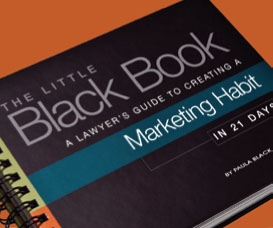
    The Little Black Book: Creating a Marketing Habit in 21 Days

    The Little Black Book: Creating a Marketing Habit in 21 Days

    Paula Black's Little Black BookFor the next 48 hours Paula Black will be offering an impressive opportunity to anyone who purchases "The Little Black Book: A Lawyer's Guide To Creating A Marketing Habit in 21 Days." Readers who purchase the book will receive "The Smart Lawyer's Toolkit," a compilation of advice from more than 30 of the most sought-after experts in the legal arena (including myself!). Click here for details.
    Tags:

    Fuente:Larry Bodine
    Difundan libremente  este artículo
    CONSULTEN, OPINEN , ESCRIBAN .
    Saludos
    Rodrigo González Fernández
    Diplomado en "Responsabilidad Social Empresarial" de la ONU
    Diplomado en "Gestión del Conocimiento" de la ONU
     
    www.consultajuridica.blogspot.com
    www.el-observatorio-politico.blogspot.com
    www.lobbyingchile.blogspot.com
    www.calentamientoglobalchile.blogspot.com
    www.respsoem.blogspot.com
    Oficina: Renato Sánchez 3586 of. 10
    Teléfono: OF .02- 2451113 y  8854223- CEL: 76850061
    e-mail: rogofe47@mi.cl
    Santiago- Chile
    Soliciten nuestros cursos de capacitación  y consultoría en LIDERAZGO -  GESTION DEL CONOCIMIENTO - RESPONSABILIDAD SOCIAL EMPRESARIAL – LOBBY – ENERGIAS RENOVABLES   ,  asesorías a nivel nacional e  internacional y están disponibles  para OTEC Y OTIC en Chile

    Posted on June 17, 2009 by Larry Bodine

    Blogger Not Surprised that Black Lawyer was Hired as "Marketing Tool"

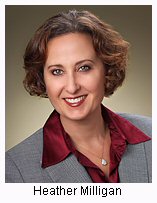
    Heather Milligan, law firm marketing, marketing directorFormer associate Venus Yvette Springs, an African-American lawyer at Mayer Brown's Charlotte, N.C., office has filed a Title VII discrimination suit that claims the law firm used her as a "marketing tool" before firing her in 2008.

    So what? says Heather M. Milligan, Director of Marketing at Barger & Wolen in Los Angeles, and author of The Legal Watercooler. She derided  the claims in the lawsuit, saying, "I hate to break the news to anyone reading this: EVERY lawyer in the firm is a potential "marketing tool" for the marketing department."

    Springs, a magna cum laude graduate of Duke Law School, alleges that when she was hired in 2007 there were only two other African-Americans at the firm's Charlotte office and no others in the real estate practice group where she worked. (For a copy of the complaint, visit Above the Law).

    "Springs was hired, in whole or in part, because the Charlotte office needed to increase its number of African-American attorneys," the suit says. "Upon information and belief, firm documents refer to the hiring of an African-American as a 'marketing tool.' Springs was used as a marketing tool, asked to attend on behalf of Mayer Brown bar and other functions where diversity would be perceived as a positive."

    Springs says she was fired despite high marks from her superiors in part to make way for a white female employee hired to bring in business from Bank of America. Above the Law reported that there were significant layoffs at Mayer Brown in November. Charlotte and New York were hit hard when the firm let go of 33 attorneys just before Thanksgiving. Mayer Brown said in a statement that they believe her claims have no merit.

    "Grow up," Milligan wrote. "We're all tools of the firm because we are part of the firm's success or lack thereof (yes, even I am a tool of the firm). "I hate to break the news to anyone reading this: EVERY lawyer in the firm is a potential "marketing tool" for the marketing department.

     
    • You write well? I'm making you editor of the blog. Tool.
    • You speak well? You are off to that conference. Tool.
    • You present well? You are representing the firm at the exhibit hall table at the industry conference. Tool.
    • You social?? I'm sending you to any and every cocktail party, table of ten I need to fill. Tool.

    "We all have a role to play. Those who embrace these roles will find success within the firm's political structure, and through their business development efforts. Those who reject it ... well, good luck finding a new job once your lawsuit hits the Internet."


    Fuente:Larry Bodine
    Difundan libremente  este artículo
    CONSULTEN, OPINEN , ESCRIBAN .
    Saludos
    Rodrigo González Fernández
    Diplomado en "Responsabilidad Social Empresarial" de la ONU
    Diplomado en "Gestión del Conocimiento" de la ONU
     
    www.consultajuridica.blogspot.com
    www.el-observatorio-politico.blogspot.com
    www.lobbyingchile.blogspot.com
    www.calentamientoglobalchile.blogspot.com
    www.respsoem.blogspot.com
    Oficina: Renato Sánchez 3586 of. 10
    Teléfono: OF .02- 2451113 y  8854223- CEL: 76850061
    e-mail: rogofe47@mi.cl
    Santiago- Chile
    Soliciten nuestros cursos de capacitación  y consultoría en LIDERAZGO -  GESTION DEL CONOCIMIENTO - RESPONSABILIDAD SOCIAL EMPRESARIAL – LOBBY – ENERGIAS RENOVABLES   ,  asesorías a nivel nacional e  internacional y están disponibles  para OTEC Y OTIC en Chile

    Green Shoots? Not So Fast...

    Indicia:

    • Is This Bull Cyclical or Secular in the WSJ, which contains the following observations as well as the following chart:

      • Many investors are now calling the rebound in stocks since early March the start of a new bull market. But it could be only a temporary respite from a longer-term bear market dating back to the beginning of this decade.[...]

        Historical data and the still struggling economy seem to point to the latter case, called a cyclical bull market in a secular bear market.

      • In late 2001, Ned Davis Research, a market analysis and money-management firm, raised the idea that stocks had entered a secular bear market, a long period of flat or declining stocks. That idea gained traction last autumn as stocks fell below levels of a decade ago [and the firm now] considers this the fourth secular bear market since 1900. The last one, from 1966 to 1982, ended when the Federal Reserve moved to aggressively crush inflation.

        Ned Davis Chart

        These "secular" cycles run for long periods; secular bull markets have lasted from six to 24 years and bear markets 13 to 16 years.

        [They also say] the rise in stocks since March 9 qualifies as a bull market, but [not] as marking a transition into a new secular rally. That is in part because, according to the firm's calculations, market valuations didn't fall far enough during the sell-off.

        [Based on Ned Davis' calculations], the S&P fell to a P/E of roughly 12 in early March and is now just shy of 16, which compares to a 40-year median of 16.5.

        "You compare that to the 1970s where we got down to P/Es below 10 and stayed there until 1982," says Tim Hayes, chief investment strategist at Ned Davis. The current secular bear market, he says, "is mature but it can go on for another several years." [...]  For now, at least, those who think this is the beginning of a long-lasting bull market are few and far between.

        BullBear

    • The ever-verbal Paul Krugman (I refrain from characterizing him further, even though he's a Nobel Prize winner from the Princeton economics department, which alone should put me in the blindly celebratory camp), wrote in today's Times under the heading Stay the Course, that it's far too soon to declare victory over the economic downturn and that those who believe "the economy is already turning around" "should be ignored" because at best the recovery policies "have pulled us a few inches back from the edge of the abyss."  He believes we're at profound risk of falling into the notorious "liquidity trap"--think Japan in the 1990's.  ("Liquidity Trap 101:"  When a country's nominal interest rate has been lowered to or nearly to zero without resulting in appreciable stimulus.  Since interest rates cannot go into negative territory, monetary policy is thus exhausted and a deflationary mindset can set in.  It ain't pretty.)

    • Far more impressively, Wharton Business School (Are Happy Days Here Again?) says, among other things:

      • Several Wharton experts express fairly pessimistic views about the recovery -- predicting that positive growth may not be here yet, and that even when it does arrive, it will probably take several years for employment rates to return to so-called normal levels. Even if the U.S. gross domestic product turns positive by the end of 2009, they note, the American economy will remain close to the bottom of the large trough that began in late 2007, with a long way to climb for jobs, home prices and other key economic indicators just to get back to where they were.

        "Many of the underlying problems remain -- and we still haven't seen the worst in terms of consumer problems."  It gets worse:

        • 12% of US homeowners are behind on their mortgages or in foreclosure
        • Consumer credit card debt may be the next shoe to drop
        • Commercial real estate hasn't even begun to come out of its swoon
        • The country as a whole is over-store'd and over-mall'd
        • Wharton finance professors tend to believe more banks need to fail.  In this regard, it's interesting that the "stress test" assumed under the worst case that unemployment would hit 8.9% this year.  Of course, it's already at 9.4% and (for my money) headed to double digits.
        • "Structural" joblessness may linger even when some leading indicators turn positive.  According to the BLS, 27% of the country's 12.5-million unemployed have been jobless for more than six months.  If sectors such as manufacturing, including the 800-pound gorilla in that sector, autos, don't recover to where they were, "many people in their late forties and early fifties may never get jobs again."
        • Consumer savings rates are now at 4.2% vs  0.9% in 2004 through 2007. 

    • Then we have the enormous question of whether interest rates will rise as investors (see:  China) decide that spiralling federal deficits as far as the eye can see demand higher returns.  Higher interest rates are of course the worst of all possible worlds at the moment:  Cyclically reinforcing higher deficits at the same time they tamp down what private sector investment may be left.  US Treasuries yields are currently at a six-month high (the 30-year bond is above 4.5% whereas as recently as January it was at 2.5%--an 80% rise).

    • Finally, permit me to add my own favorite risk:  That we are embracing "too big to fail," and that we will adopt such a super-precautionary regulatory structure that we will end up getting neither "destruction" nor "creativity" in our financial system. If we go down that politically tempting and incumbent-friendly path, we will delay our recovery by untold years and its vigor by the stunting or loss of unknowable innovations.

    And yet.

    As I talk to senior law firm leaders domestically and abroad--I am chastened to report--one of the most widespread sentiments I hear is, "We're coming out of the woods.  Aren't we?  Aren't we??"

    To be sure, I understand the strong, almost desperate, desire to hope that a return to the good old days is just around the corner.  Life was simple; life was good. 

    Yet the more I see first- and second-hand of organizations in distress, the more pivotal I believe is the power of collective denial.

    Do we need to fundamentally re-examine our business model?  Can leverage grow to the sky?  Will clients huff and puff about rate increases but ultimately (and quickly, in fact) submit?  We prefer the easy and familiar answers to these questions, not the clear-eyed and unblinking answers.

    Medicine teaches that in the human body pain serves a purpose; it alerts us to something that needs to be attended to. 

    Perhaps our world is not so different.  And fundamentally denying the message that pain may indicate the need for some change leads to the antithesis of a cure.  The morphine drip, the third glass of wine, the wishing and hoping for a return to "normal," the espying of "green shoots" while the thunderheads are rising:  None of these is healthy. 

    Have I become the anti-optimist, then?  Au contraire.  Few things are more certain in my mind than the long-run demand for sophisticated, bespoke, and yes, costly, legal services:

    • Globalization is not ending, it's accelerating.
    • Worldwide capital flows have not stopped, they're sluicing in new directions.
    • Cross-border projects will grow.
    • Regulatory regimes are not getting simpler, they're getting more complex.
    • And yes, financial innovation will--I promise you--return.

    But I'm a worried optimist, and right now the emphasis is on "worried."   I'm worried that we're not doing enough to remodel our firms for the post-Cravath System order.  I'm worried that we will not get serious about re-inventing the seriously broken associate career path model.  I'm worried that we will scurry back to the familiar dominance of the billable hour without thoughtful and heartfelt experimentation with alternative billing.  I'm worried that we will embrace complacency.  I'm worried that we will face the New Normal with a resolute stance of denial.

    Joseph Schumpeter taught us that the genius of capitalism is creative destruction.  Too many of us are focused exclusively, paralyzingly, on destruction.  To accelerate the dawn, we need to focus on creativity.

    Bernanke

    MORE INFORMATION:
     
    Fuente:adamsmithesq.
    Difundan libremente  este artículo
    CONSULTEN, OPINEN , ESCRIBAN .
    Saludos
    Rodrigo González Fernández
    Diplomado en "Responsabilidad Social Empresarial" de la ONU
    Diplomado en "Gestión del Conocimiento" de la ONU
     
    www.consultajuridica.blogspot.com
    www.el-observatorio-politico.blogspot.com
    www.lobbyingchile.blogspot.com
    www.calentamientoglobalchile.blogspot.com
    www.respsoem.blogspot.com
    Oficina: Renato Sánchez 3586 of. 10
    Teléfono: OF .02- 2451113 y  8854223- CEL: 76850061
    e-mail: rogofe47@mi.cl
    Santiago- Chile
    Soliciten nuestros cursos de capacitación  y consultoría en LIDERAZGO -  GESTION DEL CONOCIMIENTO - RESPONSABILIDAD SOCIAL EMPRESARIAL – LOBBY – ENERGIAS RENOVABLES   ,  asesorías a nivel nacional e  internacional y están disponibles  para OTEC Y OTIC en Chile

    Court Withdraws Ruling Over Judge's Conflict

    Court Withdraws Ruling Over Judge's Conflict

    The Washington Supreme Court has withdrawn a landmark ruling in a public records case in response to complaints that the opinion could benefit a separate lawsuit filed by one of the justices who decided the case. The court issued a one-page order withdrawing its earlier ruling and saying that the case will be scheduled for a new round of oral arguments "in due course." Sanders

    According to the Seattle Times, Supreme Court Justice Richard B. Sanders (pictured) wrote the majority opinion in a case that capped a 12-year quest by Armen Yousoufian to obtain documents from King County about public funding of Qwest Field. The opinion concluded that $124,000 in fines and $88,000 in attorneys' fees ordered against the county by a lower court were not nearly enough. Sanders said the fines against the county for withholding documents should have approached $100 a day, which could add up to as much as $900,000.

    But the county's lawyers complained that Sanders had a conflict of interest... [MORE]

    Sphere: Related Content

    Posted by Robert J. Ambrogi on June 17, 2009


    Fuente:
    Difundan libremente  este artículo
    CONSULTEN, OPINEN , ESCRIBAN .
    Saludos
    Rodrigo González Fernández
    Diplomado en "Responsabilidad Social Empresarial" de la ONU
    Diplomado en "Gestión del Conocimiento" de la ONU
     
    www.consultajuridica.blogspot.com
    www.el-observatorio-politico.blogspot.com
    www.lobbyingchile.blogspot.com
    www.calentamientoglobalchile.blogspot.com
    www.respsoem.blogspot.com
    Oficina: Renato Sánchez 3586 of. 10
    Teléfono: OF .02- 2451113 y  8854223- CEL: 76850061
    e-mail: rogofe47@mi.cl
    Santiago- Chile
    Soliciten nuestros cursos de capacitación  y consultoría en LIDERAZGO -  GESTION DEL CONOCIMIENTO - RESPONSABILIDAD SOCIAL EMPRESARIAL – LOBBY – ENERGIAS RENOVABLES   ,  asesorías a nivel nacional e  internacional y están disponibles  para OTEC Y OTIC en Chile

    Cloak-and-Dagger Justice

    Cloak-and-Dagger Justice

    Humphrey_Bogart2 Perhaps it was a dark and stormy night when Scott W. Stucky was sworn in as a judge of the U.S. Court of Appeals for the Armed Forces. It took place on a rain-slicked pier outside an abandoned warehouse. He wore a trenchcoat and a fedora with its brim turned down. A mysterious woman looked on, dressed all in black. The man who presided stood in a shadow, a diamond ear-stud reflecting a distant light.

    Or perhaps not. But as Michael Doyle observes at the blog Suits & Sentences, Stucky is the latest federal judge to write an opinion in the hard-boiled noir style epitomized by authors such as Dashiell Hammett and Raymond Chandler. "There was something odd about the electric razor in the bathroom," the opinion begins. "[She] typically changed clothes in the bathroom and for the past year had felt that she was being watched, a feeling that she attributed to paranoia."

    It is a style other judges have attempted, Doyle notes, with mixed results. The most notable judicial stab at noir came last year from Chief Justice John Roberts, in a dissent opposing a denial of writ of certiorari in Pennsylvania v. Dunlap. His dissent begins... [MORE]

    Sphere: Related Content

    Posted by Robert J. Ambrogi on June 17, 2009


    Fuente:
    Difundan libremente  este artículo
    CONSULTEN, OPINEN , ESCRIBAN .
    Saludos
    Rodrigo González Fernández
    Diplomado en "Responsabilidad Social Empresarial" de la ONU
    Diplomado en "Gestión del Conocimiento" de la ONU
     
    www.consultajuridica.blogspot.com
    www.el-observatorio-politico.blogspot.com
    www.lobbyingchile.blogspot.com
    www.calentamientoglobalchile.blogspot.com
    www.respsoem.blogspot.com
    Oficina: Renato Sánchez 3586 of. 10
    Teléfono: OF .02- 2451113 y  8854223- CEL: 76850061
    e-mail: rogofe47@mi.cl
    Santiago- Chile
    Soliciten nuestros cursos de capacitación  y consultoría en LIDERAZGO -  GESTION DEL CONOCIMIENTO - RESPONSABILIDAD SOCIAL EMPRESARIAL – LOBBY – ENERGIAS RENOVABLES   ,  asesorías a nivel nacional e  internacional y están disponibles  para OTEC Y OTIC en Chile