TU NO ESTAS SOLO EN ESTE MUNDO. YOU ARE NOT ALONE SI TE HA GUSTADO UN ARTICULO, COMPARTELO

Friday, January 04, 2008

Recent Posts fon legal blog watch

Saludos
Rodrigo González Fernández
DIPLOMADO EN RSE DE LA ONU
www.Consultajuridicachile.blogspot.com
www.lobbyingchile.blogspot.com
www.el-observatorio-politico.blogspot.com
Renato Sánchez 3586
teléfono: 5839786
e-mail rogofe47@mi.cl
Santiago-Chile
 
Soliciten nuestros cursos de capacitación   y asesorías a nivel internacional y están disponibles para OTEC Y OTIC en Chile

from legal blog wath


Time Again for More Criticism of the Billable Hour

It's one thing for lawyers to criticize the billable hour amongst themselves, as Scott Turow did with the publication of his essay, "The Billable Hour Must Die," in the ABA Journal.  But now, the debate over the billable hour has spilled over from lawyer publications into the mainstream press, with articles such as "The Scourge of the Billable Hour: Could Law-Firm Clients Finally Kill it Off?," that appeared online at Slate.com on January 2, 2008. 

The Slate piece makes an important, albeit obvious point: Despite persistent criticism of the billable hour by academics, lawyers and bloggers, the system won't change until clients demand a change. And according to the article, that's what clients are doing now.

As the article describes, clients' desires have always driven law firm billing practices. Hourly billing gained traction in the 1950s, partly to cater to clients who wanted more transparency. But law firms also realized that they could earn more money by billing more hours -- and thus, began increasing billable hour requirements and finding ways to encourage redundancy rather than efficiency. But now, tired of subsidizing law firm gravy trains, large corporate clients are forcing firms to offer alternative billing arrangements, such as flat fees, volume discounts and banning new associates from working on matters.

From the article, here's how the legal world might look if the trend away from the billable hour continues:

The top end of the spectrum will remain largely unchanged. Companies will still pay hourly rates to hire white-shoe law firms for specialized, bet-your-company kinds of work. On the opposite end, however, clients will stop taking their rote legal work to law firms altogether. Companies already outsource relatively simple matters like document review to consulting services. And as technology improves, more programs will let companies handle their own contracts online. In the murky middle between one-of-a-kind advice and dime-a-dozen contracts, the push for alternative arrangements will prevail.

In some ways, the legal world is changing already, and moving in this direction. As we described here, one Boston law firm has banned the billable hour entirely.  And as Indiana family law attorney Sam Hasler describes in this comprehensive post, many family law attorneys have adopted flat fee structures, finding that clients prefer these arrangements because they result in more predictable legal fees. 

At the same time, for every step forward, there are forces that hold the profession back. Old habits die hard, suggests Stephanie West Allen at Idealawg.  The lawyer brain, accustomed to grueling schedules and prone to workaholism, may resist the killing of the billable hour. Meanwhile, Barry Barnett at Blawgletter suggests that firms that can't handle this kind of complex litigation without a staff of 59 lawyers won't be offering alternative billing plans (like a contingency fee) anytime soon. 

So, is 2008 the year that we'll really see client pressure on firms to offer alternative billing, as Wired GC predicts?  Or, like the billable hour, is all of the continued talk of getting rid of it, simply redundant?

Posted by Carolyn Elefant on January 3, 2008 at 12:26 PM | Permalink | Comments (1)

Ouch -- D.C. Calls Former Lawyer and Supreme Court Litigator 'Not Indispensable'

"It's not as if one person is indispensable," said D.C. Attorney General Peter Singer to the Washington Post, explaining why his decision to fire Supreme Court litigator, Alan Morrison won't compromise the District's case before the Supreme Court in District of Columbia v. Heller. The case will address the question of whether the District's handgun ban violates the Second Amendment.  Ouch!  After all, if a Supreme Court advocate like Morrison, with twenty oral arguments under his belt and who played a substantial role in researching and drafting the District's 15,000 word brief due at the Court tomorrow is regarded as fungible, what hope is there for the rest of us?

As Tony Mauro reports at the Blog of the Legal Times, Morrison speculated that he was fired because he was viewed as a "loyalist" of Nickles' predecessor, Linda Singer, who resigned on December 21.  Nickles did not offer any additional explanation for firing Morrison, except to say that the District had decided to take a different direction in the case.  And to be fair, even without Morrison, the District's Supreme Court team still includes top talent like Tom Goldstein and Walter Dellinger, though apparently both are already booked for arguments in other cases before the Court this month and next.

What do you think?  With this kind of "dream team," does the elimination of one of the players make a difference?  Or will Nickles' decision to bench Morrison midway through the case compromise the District's chance of success at the High Court?

Posted by Carolyn Elefant on January 3, 2008 at 10:44 AM | Permalink | Comments (0)

A Lawyer Sitting With the Sharks

Some lawyer stereotypes -- such as the image of the lawyer as a shark -- are so pervasive that it's easier to embrace them rather than try to erase them.  And that's apparently what Bozeman, Montana family law attorney Chris Gillette decided to do, when he installed an eight ton shark tank in his office.  (H/T to Lowering the Bar.)  Gillette originally planned the shark tank as a joke, but then realized that it could also help create a more comfortable atmosphere for his clients, who are often dealing with stressful situations.  Of course, I don't quite understand Gillette's logic; after all, when I think of a soothing environment, a seat in close proximity to a shark tank doesn't come to mind.  At the same time, I suppose that a shark tank could help family law clients put their problems in perspective by making them realize that, bad as the court process may be, it's still better than being trapped in a tank with carnivorous fish.

In any event, based on this discussion at his Web site, Gillette doesn't seem shark-like at all.  Among other things, Gillette's Web site explains to clients that he acts cooperatively with opposing counsel and will, if appropriate, consider compromises and negotiations even if proposed by the other side. 

Posted by Carolyn Elefant on January 3, 2008 at 10:25 AM | Permalink | Comments (0)

America's Funniest Legal Videos, Online Now

Looking for a few laughs?  Well then, why settle for watching mediocre late-night TV shows that (with the exception of Letterman) remain without their writers, when you can chortle at the superior comedy of lawyers behaving hilariously at The Billable Hour's newly launched Video Venue. (H/T to Monica Bay at the Common Scold.)  According to The Video Venue (TVV), the site features video clips by, for and about lawyers, law students and legal professionals, that "can and will make you laugh, in a court of law or elsewhere." The site already includes over a hundred videos on topics such as billing, ethics, work/life balance and law school. 

To encourage lawyers to submit videos, TVV is running a contest, through January 31, 2008, to find the Funniest Legal Video on the Web, with a $50 gift certificate for the The Billable Hour online store as the grand prize. 

Posted by Carolyn Elefant on January 3, 2008 at 10:17 AM | Permalink | Comments (0)


Saludos
Rodrigo González Fernández
DIPLOMADO EN RSE DE LA ONU
www.Consultajuridicachile.blogspot.com
www.lobbyingchile.blogspot.com
www.el-observatorio-politico.blogspot.com
Renato Sánchez 3586
teléfono: 5839786
e-mail rogofe47@mi.cl
Santiago-Chile
 
Soliciten nuestros cursos de capacitación   y asesorías a nivel internacional y están disponibles para OTEC Y OTIC en Chile

Thursday, January 03, 2008

The Liberal Skew in Higher Education--Posner

The Liberal Skew in Higher Education--Posner

It is no secret that professors at American colleges and universities are much more liberal on average than the American people as a whole. A recent paper by two sociology professors contains a useful history of scholarship on the issue and, more important, reports the results of the most careful survey yet conducted of the ideology of American academics. See Neal Gross and Solon Simmons, "The Social and Political Views of American Professors," Sept. 24, 2007, available at http://www.wjh.harvard.edu/~ngross/lounsbery_9-25.pdf (visited Dec. 29. 2007); and for a useful summary, with comments, including some by Larry Summers, see "The Liberal (and Moderating) Professoriate," Inside Higher Ed, Oct. 8, 2007, available at www.insidehighered.com/news/2007/10/08/politics (visited Dec. 29. 2007).) More than 1,400 full-time professors at a wide variety of institutions of higher education, including community colleges, responded to the survey, representing a 51 percent response rate; and analysis of non-responders indicates that the responders were not a biased sample of the professors surveyed.

In the sample as a whole, 44 percent of professors are liberal, 46 percent moderate or centrist, and only 9 percent conservative. (These are self-descriptions.) The corresponding figures for the American population as a whole, according to public opinion polls, are 18 percent, 49 percent, and 33 percent, suggesting that professors are on average more than twice as liberal, and only half as conservative, as the average American. There are interesting differences within the professoriat, however. The most liberal disciplines are the humanities and the social sciences; only 6 percent of the social-science professors and 15 percent of the humanities professors in the survey voted for Bush in 2004. In contrast, business, medicine and other health sciences, and engineering are much less liberal, and the natural sciences somewhat less so, but they are still more liberal than the nation as a whole; only 32 percent of the business professors voted for Bush--though 52 percent of the health-sciences professors did. In the entire sample, 78 percent voted for Kerry and only 20 percent for Bush.

Liberal-arts colleges and elite universities are even more liberal than other types of institution of higher education. In liberal-arts colleges, the percentages liberal, conservative, and moderate are 62 percent, 4 percent, and 35 percent, respectively; and in elite universities the figures are 44 percent, 4 percent, and 52 percent. Professors in the 26 to 35 year-old age range are less liberal and more moderate (though not more conservative) than older professors, which I attribute to those youngsters' having reached maturity after the collapse of communism. It is thus no surprise that only 1 percent of the young professors describe themselves as "left radicals" or "left activists," compared to 17 percent of those aged 50 or older.

The summary in the Gross-Simmons paper of the previous literature on professorial political leanings finds that, at least since the 1950s, American college and university faculties have been more liberal than the nation as a whole, but that the liberal skew is more extreme today than it was in the 1950s. This is my experience. Between 1955 and 1962 I was a student at Yale College in the humanities and then at the Harvard Law School, and neither the humanities faculty at Yale nor the Harvard Law School faculty was noticeably liberal (the former was actually rather conservative), and I mean by the standards of that era, not by today's standards. Today both institutions are notably liberal, though the present dean of the Harvard Law School has been attempting with considerable success to make her faculty politically more diverse. The Gross-Simmons study notes that the liberal skew is not limited to the United States, but is found in Canada, Britain, and much of Continental Europe, as well.

The survey results raise two questions: What is the explanation for the results? And what are the consequences? I address only the first question.

There is nothing mysterious about the fact that the members of a particular occupational group should have a different political profile from that of the population as a whole. A 1999 survey of U.S. military officers found that 64 percent were Republican, 8 percent Democratic, and 17 percent independent. In contrast, a 2002 study found that 40 percent of journalists are liberal and 25 percent conservative--a breakdown similar to but much less extreme than that of professors.

The conservatism of military officers is easy to understand--conservatives are much more favorable to the use of military force, and to the values of honor, personal courage, discipline, hardiness, and obedience, which are highly prized by the military, than liberals are. And the liberalism of journalists probably reflects the tastes of their readers; in my 2001 book Public Intellectuals: A Study of Decline, I found that the liberal-conservative split among public intellectuals (roughly 2 to 1) corresponded to the ratio of the circulation of liberal newspapers and magazines to the circulation of conservative ones.

It is tempting to conclude that the liberal bias of journalists and professors (especially in the humanities and social sciences) is the same phenomenon--the liberalism of the "intelligentsia," usefully defined by the Merriam-Webster Online Dictionary as "intellectuals who form an artistic, social, or political vanguard or elite." But that just pushes the question back one step: why should an intelligentsia be liberal? Because intellectuals are naturally critical of their society, which in the case of the United States is rather conservative, or at least not "liberal" as academic liberals understand the word? That is not a satisfactory explanation, because a society can be attacked from the Right just as easily as from the Left. Some of the most distinguished intellectuals of the twentieth century attacked social, cultural, political, or economic features of their societies from the Right--think of Martin Heidegger, William Butler Yeats, T. S. Eliot, Friedrich Hayek, and Milton Friedman. Today, in fields such as law, political theory, and economics, there is a vibrant conservative movment--the puzzle is why it is so distinctly a minority movement in the university world. Moreover, our college and university professors, especially those whose interests and background overlap most closely with those of the majority of journalists, appear to be markedly more liberal than journalists, the other major division of the intelligentsia.

One explanatory factor may be that colleges and universities select for people who are comfortable in a quasi-socialistic working environment. Virtually all colleges and universities in the United States are either public or nonprofit, there is usually salary compression within fields, tenure shields professors from the rigors of labor-market competition, and professorial compensation substitutes fringe benefits (such as tenure), leisure, and other nonpecuniary income for high salaries. The ablest academics generally have the highest opportunity costs--the brilliant chemist could get a high-paying job in the private sector, the brilliant law professor could make a lot of money as a practicing lawyer, and so forth--which suggests that the ablest academics attach especially great value to nonpecuniary relative to pecuniary income and hence are likely to feel especially alienated from a capitalist economy.

This may be one reason why elite universities are more liberal than nonelite ones. (The greater liberalism of liberal-arts colleges may just reflect the fact that such colleges employ fewer scientists and engineers, who are less liberal on average than professors in the humanities and the social sciences.) In addition, there is the curious but well-documented fact that Jews are far more liberal than their socio-economic standing would predict; they are also disproportionately found in the faculties of elite colleges and universities. Furthermore, conservatism is associated in many people's minds with religiosity, and faculty in nontechnical fields in elite universities are rarely religious. Catholics and evangelical Christians are underrepresented in such universities. Professors who are conservative in matters of economics, crime control, and national security but liberal with regard to social issues such as abortion rights, homosexual marriage, and separation of church and state would hesitate to describe themselves as conservatives, and many would not vote Republican.

Another factor that may explain the liberal skew in the academy is political discrimination. Academics pick their colleagues, so once a department or school is dominated by liberals, it may discriminate against conservatives and thus increase the percentage of liberals. There is a good deal of anecdotal evidence of such discrimination, but the best test (though hard to "grade" in soft fields) would be whether conservative academics are abler on average than liberal ones. If conservatives are disfavored, they need to be better than liberals to be hired. Political discrimination is less likely to be prevalent in fields in which there are objective performance criteria, which may be why there is a smaller preponderance of liberals in scientific and technical fields.

Related to discrimination is herd behavior, or conformism. Despite their formal commitment to open debate, academics, like other people, do not like to be criticized or otherwise challenged. The sciences, well aware of this tendency, have institutionalized practices, such as peer review, insistence that findings be replicated, and high standards of logical and empirical rigor, that are designed to foster healthy disagreement. These practices are much less common in the humanities and the soft social sciences.

One response to discrimination or herd behavior favoring liberals in academic has been the formation of conservative think tanks; if their professional staffs were added to college and university faculties, the liberal skew would be less extreme, though the difference would not be great.

A further point also related to both discrimination and conformity bias is that once a field acquires a political cast, it will tend henceforth to attract as graduate students and thus as future professors students who share its politics, as otherwise (as Louis Menand pointed out in a comment on the Gross-Simmons study) the students may have difficulty surviving graduate school, obtaining a good starting job, and finally obtaining tenure.

My last point is what might be called the institutionalization of liberal skew by virtue of affirmative action in college admissions. Affirmative action brings in its train political correctness, sensitivity training, multiculturalism, and other attitudes or practices that make a college an uncongenial environment for many conservatives.

For all these reasons, although the weakening of left extremism in college and university faculties can be expected to continue, the liberal skew is unlikely to disappear in the foreseeable future.

Posted by Richard Posner at 05:09 PM | Comments (32) | TrackBack (0)

Events, Field, and the Liberal Skew in Higher Education-Becker


The study by Gross and Simmons discussed by Posner in part confirms what has been found in earlier studies about the greater liberalism of American professors than of the American population as a whole. Their study goes further than previous ones by having an apparently representative sample of professors in all types of colleges and universities, and by giving nuanced and detailed information about attitudes and voting of professors by field of expertise, age, gender, type of college or university, and other useful characteristics. I will try to add to Posner's valuable discussion by concentrating on the effects on academic political attitudes of events in the world, and of their fields of specialization. I also consider whether college teachers have long-lasting influences on the views of their students.

As Posner indicates, the type of persons who go into different fields varies by the characteristics of the field, so that students who become sociologists tend to be more liberal, while those who enter accounting tend to be more conservative-see Table 8 of the Gross-Simmons study on political identification of professors by field. It is also true, however, that the nature of the material analyzed in a field affects the political identification of persons in that field. The late eminent economist George J. Stigler claimed in an article many years ago that the study of economics tends to make the student more conservative because economics emphasizes that the hidden longer run effects of many government policies have much more negative consequences than the initial direct effects. Economists also show how decentralized competitive markets contribute to the general welfare. Similarly, the study of sociology emphasizes the oppressive effects of certain social forces on particular groups, like the less educated and minorities, which influence the attitudes of sociologists toward the prevailing capitalist economic system.

Admittedly, it is difficult to see the connection between the political attitudes of professors in various other fields and the nature of these fields. For example, why do less than 4 percent of historian, according to Gross and Simmons, consider themselves Republicans, whereas 23 percent of nurses do? Perhaps one important factor is that teachers in practical fields, like engineering, nursing, and medicine, see the limitations of what can be accomplished by various types of interventions, whereas those in theoretical fields, like mathematics and literature, can dream of more utopian solutions. Still, the dichotomy between the theoretical and the practical has trouble explaining why a field like history has such liberal academics since many historians deal with various disasters brought about by government ventures.

The differences in political views by age are informative. Generally, younger men and women are more liberal than older ones since age brings experience with the limitations of what can be achieved by grandiose programs. This is captured in the old adage that goes something like "if you are not a socialist when young you have no heart, but if you remain one when you get older you have no brains". Yet Table 15 in Gross and Simmons shows that academics aged 26-35 are significantly less liberal than those aged 50 and older. I suggest that events of the past 30 years are a major reason for this age-reversal on liberal tendencies. The collapse of communism, the growth of the Asian tigers that have emphasized private enterprise and export-oriented policies, the rapid development of China and India after abandoning communism and socialism, respectively, all reduced the attractiveness of Marxist, socialist, and communist ideologies. These events had less effect on the views of older academics since their views were largely determined when older academics were young, but these events had a great influence on attitudes of younger academics since their beliefs were formed while these transforming events were occurring.

Even economists, traditionally more conservative than those in other social sciences, are now much more market oriented and less sympathetic to various forms of government intervention than they were when I was a student many years ago. During the interim, not only did communism, etc collapse, but Keynesian interventionist attitudes also lost favor, and many more studies have shown the harmful effects of different attempts at government interventions in labor and other markets. The retreat among economists from interventionist policies is found not only among American academic economists, but also among younger economists in Europe and Asia, and also to some extent in Latin America. The reason is that the same forces affected economists elsewhere as affected American academic economists. I suspect, but do not have the evidence, that younger academics in other countries are also decidedly less liberal than older ones in other fields as well.

Given the indisputable evidence that professors are liberal, how much influence does that have on the long run attitudes of college students? This is especially relevant since some of the most liberal academic disciplines, like the social sciences and English, have close contact with younger undergraduates. The evidence strongly indicates that whatever the short-term effects of college teachers on the opinions of their students, the long run influence appears to be modest. For example, college graduates, like the rest of the voting population, split their voting evenly between Bush and Kerry. The influence of high incomes (college graduates earn on average much more than others), the more conservative family backgrounds of the typical college student (but less conservative for students at elite colleges), and other life experiences far dominate the mainly forgotten influence of their college teachers.

This evidence does not mean that the liberal bias of professors is of no concern, but rather that professors are much less important in influencing opinions than they like to believe, or then is apparently believed by the many critics on the right of the liberality of professors.

Saludos
Rodrigo González Fernández
DIPLOMADO EN RSE DE LA ONU
www.Consultajuridicachile.blogspot.com
www.lobbyingchile.blogspot.com
www.el-observatorio-politico.blogspot.com
Renato Sánchez 3586
teléfono: 5839786
e-mail rogofe47@mi.cl
Santiago-Chile
 
Soliciten nuestros cursos de capacitación   y asesorías a nivel internacional y están disponibles para OTEC Y OTIC en Chile

Friday, December 28, 2007

[Posible SPAM] DEMOCRACY NOW! DAILY EMAIL DIGEST

DEMOCRACY NOW! DAILY EMAIL DIGEST
December 27, 2007

= = = = = = = = =

Visit the Democracy Now! webstore today for hats, T-shirts, mugs, totebags,
books, DVDs and other holiday gift ideas or to make a year-end contribution:
http://www.democracynow.org/contribute/donate_money

= = = = = = = = =

Democracy Now! is accepting applications for internships in New York City
for the winter/spring semester. Please email admin@democracynow.org for more
information.

= = = = = = = = =

TODAY'S DEMOCRACY NOW!:

* Former Pakistani Prime Minister Benazir Bhutto Assassinated *

Former Pakistani Prime Minister Benazir Bhutto has been assassinated just
two months after returning to Pakistan from exile. She died after an
apparent suicide attack in the city of Rawalpindi. Bhutto had just addressed
an election rally when gunfire and an explosion occurred. We go to Pakistan
and simulcast part of the breaking news coverage on Dawn News and speak with
Sadaf Aziz, professor of law and policy at Lahore University of Management
Sciences, and Zia Mian, a physicist with the Program on Science and Global
Security at the Woodrow Wilson School of Public and International Affairs at
Princeton University.

Listen/Watch/Read
http://www.democracynow.org/2007/12/27/former_pakistani_prime_minister

 
* Greg Palast Reports on the Battle Between Indigenous Ecuadorians and the
U.S. Oil Giant Chevron *

Investigative Journalist Greg Palast files this report from the rainforests
of Ecuador, where an indigenous tribe is suing Chevron for $12 billion for
contaminating the Amazon. We also play part of Palast¹s interview with
Ecuador¹s President Rafael Correa.

Listen/Watch/Read
http://www.democracynow.org/2007/12/27/greg_palast_reports_

 
* Headlines for December 27, 2007 *

Ex-Pakistani Prime Minister Bhutto Assassinated
U.S. Special Forces to Expand Presence in Pakistan
Bush Signs Spending Bill Including $70B For Iraq War
Turkey Praises U.S. For Proving Intel on Northern Iraq
UNICEF: 25,000 Iraqi Children Displaced Each Month
Senate Democrats Block Recess Appointment of Author of Torture Memo
Housing Prices Plummet By Over Six Percent
Investment Banks Dole Out Record $30 Billion in Bonuses
Teenager Dies After Cigna Refused To Pay For Transplant
Deans of Journalism Schools Warn Against Media Consolidation

Listen/Watch/Read
http://www.democracynow.org/2007/12/27/headlines

= = = = = = = = =

Democracy Now!'s daily news summaries are now available in Spanish:

Read Thursday, December 27, 2007:
http://www.democracynow.org/es

To subscribe to these "Titulares de Hoy" by email, send a blank message
to: boletin-sub@list.democracynow.org

= = = = = = = = =

COMING UP ON DEMOCRACY NOW!

Friday, December 28, 2007:

* The latest news and analysis from Pakistan where former Prime Minister
Benazir Bhutto has just been assassinated. We'll be joined by blogger
and historian Manan Ahmed, author and analyst Tariq Ali, and independent
journalists and activists from Pakistan.

= = = = = = = = =

* Read Amy Goodman's latest column *

"The FCC's Christmas Gift to Big Media"

http://www.truthout.org/docs_2006/122607H.shtml

Consider writing your local newspaper and asking for them to carry the
column, distributed by King Features.  Many papers across the US have done
so already.

If you see the column in your paper, please mail us a copy of the full page,
to:

Democracy Now!
100 Lafayette St
New York, NY 10013

Thank you!

= = = = = = = = =

* New stations broadcasting Democracy Now! *

KBSU TV at Bemidji University in Bemidji, MN airs Democracy Now! at 6
p.m., M-F

Concord TV Ch. 22 in Concord, NH is now airing Democracy Now! on Monday
at 2:00 PM, Tuesday - Friday 9:00 PM

WVVY 93.7 FM in Tisbury (and Martha's Vineyard), MA is now airing
Democracy Now! at 5 p.m., M-F

WVVY, 93.7 FM in Tisbury, MA is now airing Democracy Now! at 5 p.m., M-F

= = = = = = = = =

* New stations broadcasting "Los Titulares de Hoy" (Democracy Now!'s daily
news summary in Spanish) *

The Latin American Association for Radio Education (ALER) in Quito, Ecuador,
airs the Weekly Summary of the headline news in Spanish every Sunday at 7am
on www.aler.org and via satelite.  Hundreds of stations throughout the
Americas broadcast ALER´s programming.

= = = = = = = = =

Also available as a "podcast"! Get the Democracy Now! daily show and/or the
Spanish Headlines automatically downloaded to your computer or portable
audio player. Visit http://www.democracynow.org/podcasting to see how.

= = = = = = = = =

* ATTENTION EDUCATORS *

Are you a professor, teacher, student, community organizer or home educator
who uses the Democracy Now! (DN!) program as a teaching tool? Do you use the
on line DN!  search engine for content about a specific subject? Do you show
individual programs in classes or meetings? Do you incorporate the daily
show into your curriculum or issue-based campaign? Have you found other
creative ways to use DN! as an educational resource?

We are gathering information to offer DN! as a resource to educational
institutions and programs. Note we also offer copies of the show in several
formats at a 50% discount to educators. Please share your experiences with
us by writing to (please include your contact info):
education@democracynow.org.

= = = = = = = = =

Please forward this to friends and family and encourage them to subscribe.

= = = = = = = = =

To unsubscribe: send a blank email digest-unsub@list.democracynow.org
Check for detailed instructions in email below.


= = = = = = = = =
ABOUT DEMOCRACY NOW!
Democracy Now! airs on over 500 radio and TV stations, including
Pacifica, NPR, community, and college radio stations; on public
access, PBS, satellite TV stations (DISH network: Free Speech TV
ch. 9415 and Link TV ch. 9410; DIRECTV: Link TV ch. 375); on the World
Radio Network's European Service and on the Community Broacasting
Association of Australia service; as a "podcast", automatically
downloaded to your computer or portable audio player; and streams live
M-F at 8am EST at www.democracynow.org
= = = = = = = = =
Now real-time CLOSED CAPTIONED on TV!
You can also view/listen/read all Democracy Now! shows online:
http://www.democracynow.org
To bring Democracy Now! to your community, go to:
http://www.democracynow.org/bringDNtoyou.html
= = = = = = = = =
Saludos
Rodrigo González Fernández
DIPLOMADO EN RSE DE LA ONU
www.Consultajuridicachile.blogspot.com
www.lobbyingchile.blogspot.com
www.el-observatorio-politico.blogspot.com
Renato Sánchez 3586
teléfono: 5839786
e-mail rogofe47@mi.cl
Santiago-Chile
 
Soliciten nuestros cursos de capacitación   y asesorías a nivel internacional y están disponibles para OTEC Y OTIC en Chile

Thursday, December 27, 2007

'Pakistan: Bhutto's Death and Impending Elections'

'Pakistan: Bhutto's Death and Impending Elections'
by Neha Viswanathan

Still reeling with the shock, The Emergency Times, which has kept a very close eye on the unfolding political situation in Pakistan, writes

At this tragic moment in the history of Pakistan, we at the Emergency Times are shocked beyond words at this intolerable and brutal act of the murder, along with others, of possibly the most popular leader of our country. No words can adequately condemn this barbaric act, which can only lead to more death and destruction for this tortured land. Her death will leave a gaping chasm in our country's leadership. One can only hope, beyond hope, that the perpetrators are brought to justice.
May God help us all.

Pickled Politics links to the news and a commenter writes "Assassination of leading political figures is a very bad sign for a society, for it shows a clear and direct lack of trust and respect for the institutions of the state and society. One can only hope that the perpetrators are brought to justice."

Some other perspectives have also emerged, looking at Bhutto both as a possible leader and a mover in international politics. Counter Terrorism Blog says

She was someone who the U.S. could actually work with to seek a way forward for Pakistan in light of the profound challenges posed by religious intolerance and political extremism, the drug trade, governmental institutions that do not provide essential services in many areas of the country, and Pakistan's troubled relationships with of its immediate neighbors -- Afghanistan, India, and Iran.

Her faults were also profound, as the well-documented grand corruption cases brought against her and her husband attest. She did indeed treat her country like it was a family-owned business, with corrosive results. These includied her removal from power in 1990 and again in 1996 as the corruption both weakened her politically and played a significant role in her inability to deliver the reforms needed to make Pakistan's government responsive to the needs of its people

The Moderate Voice has a bio on Benazir Bhutto, including information on her father who was also the Prime Minister of Pakistan, and was sentenced to death in the 70s for charges similar to the ones Benazir faced much later.

From across the border, Indian Muslims comment on the assassination, and debate various conspiracy theories.

The hands of Nawaz Sharif cannot be completely ignored as he too had his reason for her removal: He now is the only national level leader who has experience as a Prime Minister. He is now sure to take over as PM of Pakistan. The chances of this conspiracy are rare but you never know with these opportunistic and individualistic politicians.

Meanwhile, Sepia Mutiny's post on Bhutto's death already has over a hundred comments. One commenter says

One wonders if she truly felt she would be safe in Pakistan. Love of country and desire to contribute aside, is there some shred of a risk-taking thrill inherent in this endeavor she had embarked upon? Some level of martyrlike delusion, however deeply buried? Can any of us imagine being devoted enough to any political cause to risk our life so boldly? Was it worth it, Benazir?

Truly sad. Whither Pakistan?

You may view the latest post at
http://www.globalvoicesonline.org/2007/12/27/pakistan-bhuttos-death-and-impending-elections/

--------------------------------------------------------------------------------------------------------
You received this e-mail because you asked to be notified when new updates are posted.
If you no longer wish to receive notifications of new posts then please visit:
http://www.globalvoicesonline.org/subscribe.php


Best regards,
The Global Voices Team
globalvoices.online@gmail.com
Saludos
Rodrigo González Fernández
DIPLOMADO EN RSE DE LA ONU
www.Consultajuridicachile.blogspot.com
www.lobbyingchile.blogspot.com
www.el-observatorio-politico.blogspot.com
Renato Sánchez 3586
teléfono: 5839786
e-mail rogofe47@mi.cl
Santiago-Chile
 
Soliciten nuestros cursos de capacitación   y asesorías a nivel internacional  en lobby y están disponibles para OTEC Y OTIC en Chile

Tuesday, December 25, 2007

The Christmas Broadcast 2007

British Monarchy - Media Centre
 
 
The Christmas Broadcast 2007

One of the features of growing old is a heightened awareness of change.  To remember what happened 50 years ago means that it is possible to appreciate what has changed in the meantime.  It also makes you aware of what has remained constant.

In my experience, the positive value of a happy family is one of the factors of human existence that has not changed.  The immediate family of grandparents, parents and children, together with their extended family, is still the core of a thriving community.

When Prince Philip and I celebrated our Diamond Wedding last month, we were much aware of the affection and support of our own family as they gathered round us for the occasion.
 
Now today, of course, marks the birth of Jesus Christ.  Among other things, it is a reminder that it is the story of a family; but of a family in very distressed circumstances.  Mary and Joseph found no room at the inn; they had to make do in a stable, and the new-born Jesus had to be laid in a manger.  This was a family which had been shut out.

Perhaps it was because of this early experience that, throughout his ministry, Jesus of Nazareth reached out and made friends with people whom others ignored or despised.  It was in this way that he proclaimed his belief that, in the end, we are all brothers and sisters in one human family.

The Christmas story also draws attention to all those people who are on the edge of society - people who feel cut off and disadvantaged; people who, for one reason or another, are not able to enjoy the full benefits of living in a civilised and law-abiding community.  For these people the modern world can seem a distant and hostile place.

It is all too easy to 'turn a blind eye', 'to pass by on the other side', and leave it to experts and professionals.  All the great religious teachings of the world press home the message that everyone has a responsibility to care for the vulnerable.  Fortunately, there are many groups and individuals, often unsung and unrewarded, who are dedicated to ensuring that the 'outsiders' are given a chance to be recognised and respected.  However, each one of us can also help by offering a little time, a talent or a possession, and taking a share in the responsibility for the well-being of those who feel excluded.

And also today I want to draw attention to another group of people who deserve our thoughts this Christmas.  We have all been conscious of those who have given their lives, or who have been severely wounded, while serving with the Armed Forces in Iraq and Afghanistan.  The dedication of the National Armed Forces Memorial was also an occasion to remember those who have suffered while serving in these and every other place of unrest  since the end of the Second World War. 

For their families, Christmas will bring back sad memories, and I pray that all of you, who are missing those who are dear to you, will find strength and comfort in your families and friends.
 
A familiar introduction to an annual Christmas Carol Service contains the words: 'Because this would most rejoice his heart, let us remember, in his name, the poor and the helpless, the cold, the hungry, and the oppressed; the sick and those who mourn, the lonely and the unloved.'

Wherever these words find you, and in whatever circumstances, I want to wish you all a blessed Christmas.add text here.

View this year's Christmas Broadcast on the BBC's website.

Receive an audio file of the Christmas Broadcast as a podcast.

Listen to the Christmas Broadcast.

Read transcripts of past Christmas Broadcasts.

Saludos
Rodrigo González Fernández
DIPLOMADO EN RSE DE LA ONU
www.Consultajuridicachile.blogspot.com
www.lobbyingchile.blogspot.com
www.el-observatorio-politico.blogspot.com
Renato Sánchez 3586
teléfono: 5839786
e-mail rogofe47@mi.cl
Santiago-Chile
 
Soliciten nuestros cursos de capacitación   y asesorías a nivel internacional y están disponibles para OTEC Y OTIC en Chile

United Nations Framework Convention on Climate Change

United Nations Framework Convention on Climate Change  
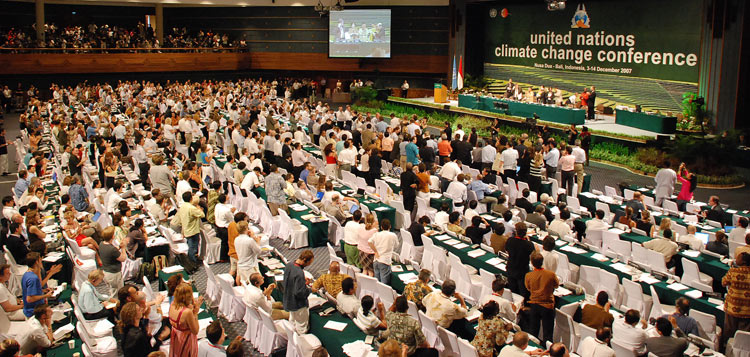
United Nations Climate Change Conference - Bali, 3 - 14 December 2007
Delegates rise to applaud the decision to adopt the Bali roadmap for a future international agreement on climate change
Delegates rise to applaud the decision to adopt the "Bali roadmap" for a future international agreement on climate change

The Conference, hosted by the Government of Indonesia, took place at the Bali International Convention Centre and brought together representatives of over 180 countries together with observers from intergovernmental and nongovernmental organizations, and the media. The two week period included the sessions of the Conference of the Parties to the UNFCCC, its subsidiary bodies as well as the Meeting of the Parties of the Kyoto Protocol. A ministerial segment in the second week concluded the Conference.
Decisions adopted by COP 13 and CMP 3

webcast View On-demand webcast


News  

Kyoto Protocol's Clean Development Mechanism passes 100 millionth certified emission reduction milestone
Bonn, Germany
18 December 2007
The 100 millionth certified emission reduction (CER) credit under the Kyoto Protocol's Clean Development Mechanism has been issued, marking an important environmental, development and carbon market milestone on the road to a low-carbon future.
pdf-icon Press release (130 kB)

COP 13

UN Breakthrough on climate change reached in Bali
Nusa Dua, Bali, Indonesia
15 December 2007
187 countries meeting in Bali on Saturday agreed to launch
negotiations towards a crucial and strengthened international climate change deal.
pdf-icon Press release (57 kB) pdf-icon esp (144 kB) pdf-icon fre (151 kB) pdf-icon rus (158 kB) pdf-icon ger (168 kB)

Secretary-General of the United Nations Ban Ki-moon

UN Secretary-General: "Eyes of the world" on Ministers and Heads of State meeting at United Nations Climate Change Conference in Bali
Nusa Dua, Bali, Indonesia
12 December 2007
144 ministers and high-level government representatives along with 6 heads of state gathered in Bali on Wednesday to begin the high-level segment of the United Nations Climate Change Conference - Bali 2007, which is expected to launch negotiations on a new global deal on climate change.
pdf-icon Press release (131 kB)

COP 13

Solid input from businesses indispensable in future climate change talks
Nusa Dua, Bali, Indonesia
10 December 2007
UNFCCC Executive Secretary Yvo de Boer has called for the active engagement of the international business community in the talks on a future climate change deal. "You are the key to a low carbon future. If Bali will do what I hope it will do, we are facing the enormous challenge of shaping a post 2012 climate change deal in only two years time. Your input is indispensable to frame a deal that is not only effective in terms of emission reductions, but also makes economic sense." The call came in an opening statement by Mr. de Boer at the Bali Global Business Day, a joint initiative of the World Business Council of Sustainable Development and the International Chamber of Commerce.
pdf-icon Statement (30 kB)

Nairobi Framework Important steps taken to expand CDM in Africa, much remains to be done – Nairobi Framework partners
Nusa Dua, Bali, Indonesia
6 December 2007
A good start has been made to extend the benefits of the clean development mechanism (CDM) to Africa, but a great deal more remains to be done, and much more is needed in terms of donor support, say representatives of the five agencies implementing the Nairobi Framework aimed at spreading the benefits of the CDM.
pdf-icon Press release (120 kB)
COP 13 United Nations Climate Change Conference in Bali poised for political breakthrough
Nusa Dua, Bali, Indonesia
3 December 2007
The United Nations Climate Change Conference - Bali, 2007 got underway Monday, poised for a breakthrough in international climate change negotiations.
pdf-icon Press release (130 kB) pdf-icon esp (132 kB) pdf-icon fre (153 kB) pdf-icon rus (162 kB) pdf-icon ger (132 kB)

Press Briefing: Making the Kyoto Protocol work: data, policies and infrastructure and briefing on the expected outcomes of the UN Climate Change Conference in Bali
Bonn, Germany
20 November 2007
The Climate Change Secretariat presented detailed emissions data provided by the 41 industrialized nations which are Parties to the United Nations Framework Convention on Climate Change. The information was presented by UNFCCC Executive Secretary Yvo de Boer and by a team of UNFCCC emission data experts. A special focus was given to progress in combating climate change under the Kyoto Protocol, with a close look at emissions data of Kyoto Protocol Parties.
pdf-icon Press release (53 kB) pdf-icon ger (56 kB)
Fact sheets and presentations from the press briefing
National greenhouse gas inventory data for the period 1990-2005.

webcast View on-demand webcast


In Focus  
Bali

New publication
A new publication from the UNFCCC has been released highlighting the concerns and needs of developing countries in adapting to the effects of climate change. pdf-icon Climate change: Impacts, vulnerability and adaptation in developing countries (3176 kB) draws heavily on information provided at the regional workshops on adaptation under decision 1/CP.10.

Saludos
Rodrigo González Fernández
DIPLOMADO EN RSE DE LA ONU
www.Consultajuridicachile.blogspot.com
www.lobbyingchile.blogspot.com
www.el-observatorio-politico.blogspot.com
Renato Sánchez 3586
teléfono: 5839786
e-mail rogofe47@mi.cl
Santiago-Chile
 
Soliciten nuestros cursos de capacitación   y asesorías a nivel internacional  BIOCOMBUSTIBLES Y CALENTAMIENTO GLOBAL y están disponibles para OTEC Y OTIC en Chile PARA 2008

CHILEAN National Symbols

National Symbols PDF Print E-mail

In the early days of the Republic of Chile, it became necessary to create official symbols for the new state of Chile. The national symbols would not only promote the international recognition of Chile as a country, but also would have to be commonly identified by the Chilean people.

The current national symbols, such as the Chilean flag, the national hymn and the coat of arms, were only officially approved after undergoing various changes; what they represented underwent some changes as well.

Here, you can get to know the origins of these emblems and how they have changed over the years.

 The Flag

 The Coat of Arms

 The Anthem


Saludos
Rodrigo González Fernández
DIPLOMADO EN RSE DE LA ONU
www.Consultajuridicachile.blogspot.com
www.lobbyingchile.blogspot.com
www.el-observatorio-politico.blogspot.com
Renato Sánchez 3586
teléfono: 5839786
e-mail rogofe47@mi.cl
Santiago-Chile
 
Soliciten nuestros cursos de capacitación   y asesorías a nivel internacional y están disponibles para OTEC Y OTIC en Chile

Sunday, December 09, 2007

Welcome to the United Nations Climate Change Conference in Bali

Welcome to the United Nations Climate Change Conference in Bali  
COP 13

The Conference, hosted by the Government of Indonesia, is taking place at the Bali International Convention Centre and brings together representatives of over 180 countries together with observers from intergovernmental and nongovernmental organizations, and the media. The two week period includes the sessions of the Conference of the Parties to the UNFCCC, its subsidiary bodies as well as the Meeting of the Parties of the Kyoto Protocol. A ministerial segment in the second week will conclude the Conference.

What is needed is a breakthrough in the form of a roadmap for a future international agreement on enhanced global action to fight climate change in the period after 2012, the year the first commitment period of the Kyoto Protocol expires. The main goal of the Bali Conference is threefold: to launch negotiations on a climate change deal for the post-2012 period, to set the agenda for these negotiations and to reach agreement on when these negotiations will have to be concluded.

8 December
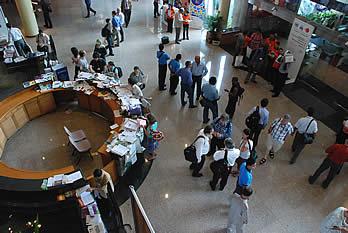
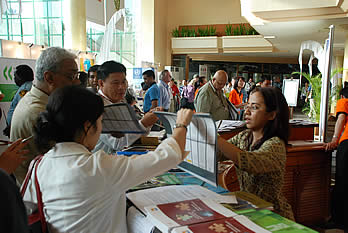
photo
Participants swap views at the conference venue
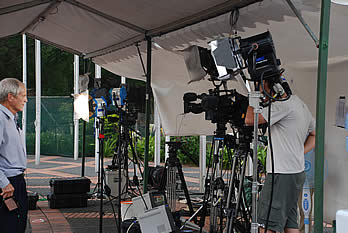
Photo
Media covering the conference on-site 
Summary of daily press briefing
Yvo de Boer - COP 13, Bali, 8 December 2007
Optimism at halfway stage in negotiations
Download as Podcast

As negotiations on a future climate deal reached the halfway stage in Bali, there was optimism that progress was being made on the main building blocks which will shape the agreement.

After what he described as a busy week of talks, UNFCCC Executive Secretary, Yvo de Boer, spoke of a "strong willingness" by Parties for an outcome at the conference, which has attracted more than 10.000 participants, including delegates, NGO's, international organizations and the media.

Mr. de Boer explained that the two-week conference needs to deliver on ongoing issues of particular importance to developing countries. This means moving forward on adapation, transfer of technology and deforestation, as well as strengthening capacity-building. What the conference also needs to do is launch a process on action beyond 2012, when the first commitment period of the Kyoto Protocol ends. Mr. de Boer reiterated that no final deal on a future climate regime will be concluded at Bali, and that the goal is to launch negotiations, set an agenda on the main building blocks of a future agreeement and set an end date for conclusion of the negotiations.

Read full summary

7 December
IPCC Briefing on the Fourth Assessment Report, with emphasis on its synthesis report Presentations
Participants receives the awaited 2008 Rio Conventions Calendar at the Convention Centre.
Participants receive the awaited 2008 Rio Conventions Calendar at the Convention Centre.
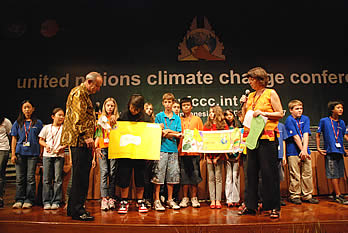
ZOOM– Kids on the move 2007
Children from Sunrise School, Kerobokan, Bali handing over "Green Footprints" to UNFCCC Executive Secretary Yvo de Boer on behalf of more than 128,000 children from around the world.
Summary of daily press briefing
Yvo de Boer - COP 13, Bali, 7 December 2007
Financing the response to climate change
Download as Podcast

As formal talks continued at the climate negotiations in Bali, UNFCCC Executive Secretary, Yvo de Boer, said that the process on shaping a roadmap for a post-2012 climate agreement was continuing to go well.

The contact group on the future had "substantive discussions on objectives and principles that should guide the negotiating process beyond Bali," he said, while useful discussions had also taken place on mitigation - one of the main building blocks of a future agreement. He added that the need to give developing countries emission reduction incentives had come up very strongly, as well as recognition of what they are doing now.

The focus of today's press briefing was on financing the response to climate change. Mr. de Boer stated that economic and financial instruments form an important part of the solution to climate change, and described the financial component of the debate as "the key to success as we move into the future."

Read full summary

6 December
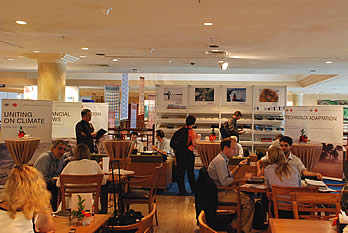
UNFCCC's Climate Change Kiosk at BICC
UNFCCC's Climate Change Kiosk at the BICC
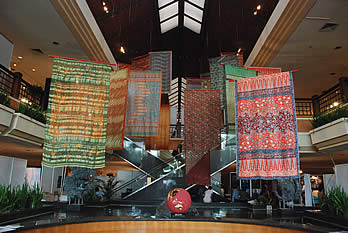
Balinese batik sarungs in the Convention Centre
Balinese batik sarungs displayed in the Convention Centre
Summary of daily press briefing
Yvo de Boer - COP 13, Bali, 6 December 2007
State of play and Kyoto mechanisms
Download as Podcast
As the first meetings of the contact groups got under way today, UNFCCC Executive Secretary, Yvo de Boer, spoke of "a good mood in the air " and said the meetings were "going well."

The work of the special group on the future, which began yesterday and continued today, is generating "a huge amount of interest, " he said. Brazil (on behalf of the G77), China, the United States, Japan and the European Union have all come forward with suggestions on what the Bali roadmap should look like and what needs to be included in a long-term climate change policy. He described the fact that many countries have come prepared with their own proposals on how the process should move forward as "encouraging."

On the recurring subject of emissions targets, Mr. de Boer emphasized that "what is clear to everyone is that industrialized countries must continue to take the lead and must reduce their emissions by 25-40% by 2020. That is the agreed range for industrialized countries."

Read full summary

Previous days
Saludos
Rodrigo González Fernández
DIPLOMADO EN RSE DE LA ONU
www.Consultajuridicachile.blogspot.com
www.lobbyingchile.blogspot.com
www.el-observatorio-politico.blogspot.com
Renato Sánchez 3586
teléfono: 5839786
e-mail rogofe47@mi.cl
Santiago-Chile
 
Soliciten nuestros cursos de capacitación   y asesorías a nivel internacional en calentamiento global  y están disponibles para OTEC Y OTIC en Chile

Friday, December 07, 2007

Special Report WARTON

Special Report
The Power of Knowledge-Based Partnerships
As China, India and other emerging economies continue to grow by leaps and bounds, business leaders, academics and government officials recently met at the University of Delaware to discuss new strategies to reinforce U.S. competitiveness. At a conference titled, "Creating Knowledge-Based Partnerships: Challenges and Opportunities," speakers -- including DuPont CEO Chad Holliday -- called for a new emphasis on engineering, education and investment in research and development to stimulate scientific discovery and business growth in Delaware and across the nation. Knowledge@Wharton offers an overview of the conference and the kinds of partnerships it will take to succeed in the global economy.
http://knowledge.wharton.upenn.edu/weblink/359.cfm
_________________________________________________________________

Special Report
Booking Time
Whatever the season, curling up with a good book -- or a good e-book reader -- is an appealing prospect. To encourage that process, we offer another of our special book sections covering a variety of topics and disciplines. You can learn how to better manage the identity of your company, how to create innovative products by tapping into the 'global brain,' and how to more accurately predict, analyze and deal with financial crises. You can also read about the ways in which prosperity has transformed America, why the debate over the corking of wine bottles has assumed near-epic proportions (for some), why it's important to bring out your 'inner economist,' and how the wisdom of crowds can help your business become more profitable. We hope you enjoy the knowledge and insights these books offer.
http://knowledge.wharton.upenn.edu/weblink/360.cfm
_________________________________________________________________

The Soul of the Corporation: Managing Your Company's Identity
(Podcast with Transcript)
McDonald's operates the biggest restaurant chain in France. The company's franchisees are French, as are their employees, and they also source their supplies from France. And yet, most people in that country regard McDonald's as an American firm that is undermining the French way of life. That is a good example of how the question of corporate identity has become complex and confused today because of globalization, according to Hamid Bouchikhi, professor of management and entrepreneurship at ESSEC, and Wharton management professor John Kimberly. The two are authors of a new book titled, The Soul of the Corporation: How to Manage the Identity of Your Company (Wharton School Publishing). How can a company cut through this confusion and use the notion of identity as a source of competitive advantage? Kimberly answers that question and others in an interview with Knowledge@Wharton.
http://knowledge.wharton.upenn.edu/article/1858.cfm

Want to Create Innovative Products? Tap into the 'Global Brain'

In their quest to harness new sources of creativity, companies are reaching beyond their R&D labs to tap individuals and organizations outside their corporate boundaries. In their new book titled, The Global Brain: Your Roadmap for Innovating Faster and Smarter in a Networked World (Wharton School Publishing), Satish Nambisan, a professor of technology management and strategy at the Lally School of Management at the Rensselaer Institute of Technology, and Mohanbir Sawhney, a professor of technology at Northwestern University's Kellogg School of Management, explore the rise and implications of this network-centric approach to managing innovation. Nambisan spoke with India Knowledge@Wharton recently about how companies can work with outsiders to enhance their own efforts to create new products and services.
http://knowledge.wharton.upenn.edu/india/article.cfm?articleid=4244

The Anatomy of Financial Crises: Understanding Their Causes and Consequences

Crises have been a feature of the financial landscape for hundreds of years. They often appear with little warning, as the sub-prime mortgage crisis of 2007 and the Asian crisis of 1997-1998 illustrate. It's not always clear what causes crises, whether they can be avoided and how their impact can be reduced. A recent book, titled Understanding Financial Crises (Oxford University Press), by Wharton finance professor Franklin Allen and Douglas Gale, a professor of economics at New York University, tackles this subject from a number of different angles. The authors review the history of financial crises in addition to offering their own approach to examining the underlying causes. Allen and Gale also discuss asset price volatility, the interaction between banks and markets, bubbles and financial contagion, among other topics. Knowledge@Wharton offers an excerpt from the book.
http://knowledge.wharton.upenn.edu/article/1856.cfm

How America's 'Age of Abundance' Has Paved the Road to the 'Pursuit of Happiness'

Forty years after the Summer of Love, the 1960s are still in style. The Grateful Dead have their own ice cream flavor and young Americans are still into peace, love and pot. But what we tend to forget is that during that same summer, 18,000 people converged on Tulsa, Okla., for the formal dedication of Oral Roberts University, a ceremony that marked the success of modern evangelical Protestantism. Although we tend to see ourselves as emerging from one or the other of these histories, Brink Lindsey argues in his book, The Age of Abundance: How Prosperity Transformed America's Politics and Culture (Collins), that we are all descendants of both. His thesis is centered on the American economy, and suggests that our country's thriving market has become an engine for a vibrant new culture of choice and opportunity.
http://knowledge.wharton.upenn.edu/article/1853.cfm

To Cork or Not to Cork: The Wine Industry's Battle over the Bottleneck
(Podcast and Video Webcast with Transcript)
Anyone who has popped open a bottle of wine will agree with George Taber that it is one of the few sounds in the world that brings true joy to the listener. But if the opponents of cork have their way, that sound might disappear, as Taber, a veteran business journalist and author, explains in his new book, To Cork or Not to Cork: Tradition, Romance, Science, and the Battle for the Wine Bottle (Scribner). As Taber tells it, although cork has been used to seal virtually every bottle of wine for nearly three centuries, that dominance is now under attack by other forms of closure, including screw caps, plastic seals and glass stoppers. Taber talks with Knowledge@Wharton about the battle and his book.
http://knowledge.wharton.upenn.edu/article/1857.cfm

Economics for Humans: Tyler Cowen on Using Incentives for a Better Life

Tyler Cowen wants to help you live a richer, more rewarding life -- and no, he's not an executive coach, televangelist or diet guru. Rather, he is the latest in a series of economists applying academic insights to everyday life. In his new book, Discover Your Inner Economist: Use Incentives to Fall in Love, Survive Your Next Meeting, and Motivate Your Dentist (Dutton Adult), Cowen, a professor of economics at George Mason University, argues that by understanding the power of incentives -- rather than just the power of money -- you can better accomplish your goals. In an interview with Knowledge@Wharton, Cowen talks about Adam Smith's inner drive, why optimistic CEOs may be a bad bet, and blogging. Cowen is trying, he says, "to make economics more human."
http://knowledge.wharton.upenn.edu/article/1854.cfm

We Are Smarter Than Me: How the Wisdom of Crowds Can Help Businesses Succeed

In We Are Smarter Than Me (Wharton School Publishing), authors Barry Libert and Jon Spector -- and a community of more than 4,000 people who contributed insights to the book -- illustrate how businesses can profit from the wisdom of crowds. Using case studies from product development, manufacturing, marketing, customer service, finance and management, the book, whose subtitle is How to Unleash the Power of Crowds in Your Business, shows what works, and what doesn't, when managers try to build community into their decision making. Knowledge@Wharton excerpts parts of Chapter Two, titled "Go from R&D to R&We."
http://knowledge.wharton.upenn.edu/article/1855.cfm

_________________________________________________________________

Help Spread Knowledge

Do you know people who might be interested in these research studies and
more? If you do, please forward this e-mail message to them.
The Knowledge@Wharton Newsletter is a free service of the Wharton School
(http://www.wharton.upenn.edu/) of the University of Pennsylvania. Its
companion web site, Knowledge@Wharton, includes full details of the
stories listed here.
To read these stories, go to
http://knowledge.wharton.upenn.edu/
To read Universia-Knowledge@Wharton, our Spanish/Portuguese Partnership
http://www.wharton.universia.net
To read the Chinese Version of Knowledge@Wharton
http://www.knowledgeatwharton.com.cn
To comment on these stories, go to:
http://knowledge.wharton.upenn.edu/feedback.cfm
To unsubscribe from this newsletter, visit:
http://knowledge.wharton.upenn.edu/unsubscribe.cfm

Sponsorship Inquiries
Visit our media kit to find out about opportunities to sponsor Knowledge@Wharton special reports, newsletters, and our site.
http://knowledge.wharton.upenn.edu/media/

Saludos
Rodrigo González Fernández
DIPLOMADO EN RSE DE LA ONU
www.Consultajuridicachile.blogspot.com
www.lobbyingchile.blogspot.com
www.el-observatorio-politico.blogspot.com
Renato Sánchez 3586
teléfono: 5839786
e-mail rogofe47@mi.cl
Santiago-Chile
 
Soliciten nuestros cursos de capacitación   y asesorías a nivel internacional y están disponibles para OTEC Y OTIC en Chile